The subsurface conditions between the older residential areas near Nose Creek and the newer developments on the western moraine differ considerably in Airdrie. In the valley, you often encounter stiff glacial till with cobbles, while the plateau presents denser sand and gravel layers. Our Standard Penetration Test in Airdrie is calibrated to handle both scenarios, using a 63.5 kg hammer with a 760 mm drop, as per CSA A23.2-9A / CSA A23.2-9A / CSA A23.2-9A / CSA A23.2-9A / CSA A23.2-9A / ASTM D1586. We record N-values every 1.5 m, but in the till zones we sometimes test at 0.75 m intervals to capture thin, dense layers. This granular data feeds directly into bearing capacity calculations for residential and commercial foundations, and we always correlate the blow counts with local gravel content to avoid overestimating density. For projects requiring a broader subsurface picture, we integrate the SPT results with a detailed clasificación de suelos to confirm soil type boundaries across the site.
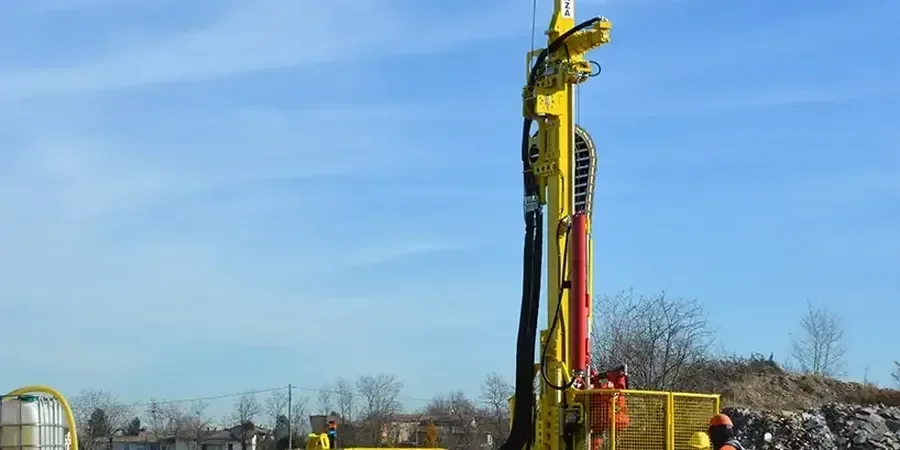
In Airdrie's glacial till, uncorrected N-values can overestimate density by 30% if gravel content exceeds 15% by volume.
Methodology applied in Airdrie
- N-value (blows per 0.3 m) for relative density estimation
- Energy ratio correction (ERi) per ASTM D4633
- Hammer efficiency calibration using a Pile Driving Analyzer
- Correction for overburden pressure (CN) per Liao & Whitman
Risks and considerations in Airdrie
One of the most common mistakes we see in Airdrie is relying on raw N-values from the first 3 m of the borehole. The upper till here often contains cobbles that can jam the split spoon, giving artificially high blow counts that suggest a very dense soil when in reality the matrix is medium-dense. If you use those uncorrected values for shallow foundation design, you risk underestimating settlement once the cobble fraction is displaced during excavation. Our protocol includes a mandatory 24-hour review of the SPT logs against the drilling notes; if cobble refusal is suspected, we rerun the test at a nearby offset borehole. This local quirk is why we always complement the SPT with a granulometría of the sampled material to confirm the actual grain-size distribution.
Our services
We offer two complementary SPT-based services tailored to Airdrie's conditions.
Standard SPT for Residential Foundations
Boreholes to 8 m depth with SPT at 1.5 m intervals. Includes N60 correction, energy ratio verification, and a summary table for bearing capacity per NBCC. Ideal for single-family homes and small commercial slabs.
Advanced SPT with Seismic Site Classification
Extended boreholes to 15 m or refusal, with SPT every 1 m. Includes correction for overburden, fines content, and calculation of Vs30 correlation using the Ohta & Goto method. Provides site class A–F per NBCC 2020.
Common questions
How deep do you typically drill for SPT in Airdrie?
For most residential projects we drill to 8 m, but on sites with deep glacial till or suspected organic pockets we go to 15 m or until refusal on bedrock. The depth is always tailored to the foundation load and the local soil profile.
What is the difference between raw N-value and corrected N60?
The raw N-value is the blow count recorded in the field. N60 corrects that value for hammer energy efficiency (ERi) to a standard 60% energy ratio. In Airdrie, where automatic hammers are common, the correction factor typically ranges from 1.1 to 1.3.
Can SPT be performed in frozen ground during winter?
Yes, but we recommend waiting until the active layer thaws. If winter testing is unavoidable, we use a heated shelter and insulated rods, and we apply a correction factor for frost penetration. The reliability of blow counts in frozen till is lower, so we prefer late spring campaigns.
How does the SPT data affect foundation design for Airdrie's glacial till?
The corrected N-values are used to estimate the unconfined compressive strength of the till (qu ≈ N60 * 12.5 kPa) and to assign a presumptive bearing capacity per NBCC. For till with N60 between 20 and 40, typical allowable bearing pressures range from 150 to 250 kPa, but we always verify with settlement analysis.
What is the typical cost range for an SPT investigation in Airdrie?
For a standard residential investigation with two boreholes to 8 m, the cost typically ranges between CA$720 and CA$1,070, depending on site access and the number of SPT tests required. Larger commercial projects with deeper boreholes and correction analysis are quoted individually.