I walked a site near the Airdrie railway corridor last month. The client was pouring a slab for a light industrial unit. The soil looked dirty — lots of fines mixed with gravel. We ran a grain size analysis right there in the field lab. The hydrometer revealed 18% silt content that the sieve alone missed. That changed the compaction specs entirely. In Airdrie, you cannot guess the particle distribution. Glacial till, lacustrine clay, and fluvial sand all appear within one block. A proper grain size analysis separates the fractions and tells you exactly what you are compacting. Without it, you risk differential settlement under the slab. We follow CSA + CSA + CSA + CSA + CSA + CSA + ASTM D422 (also CFEM Ch 2) (also CFEM Ch 2) (also CFEM Ch 2) (also CFEM Ch 2) (also CFEM Ch 2) and D6913 for the combined sieve and hydrometer method. The data feeds directly into the bearing capacity calculation. Before we place fill, we also run an ensayo Proctor to match moisture-density targets. That combo — gradation plus Proctor — has saved countless rework hours on Airdrie projects.
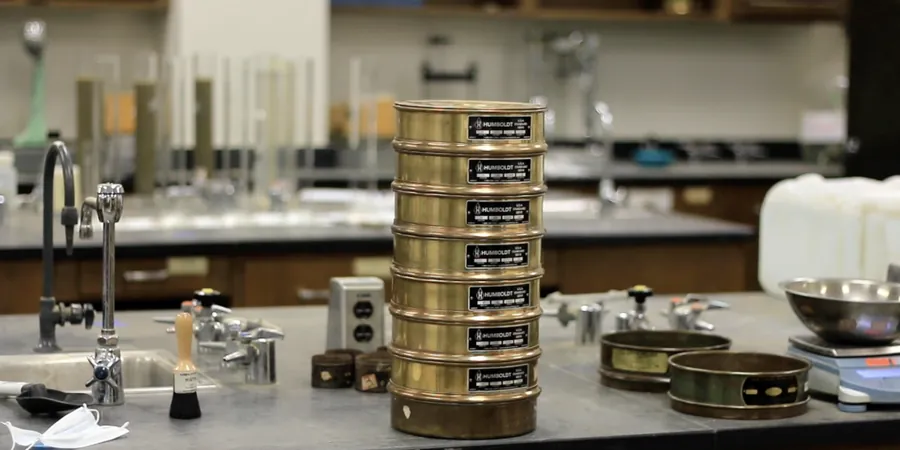
A single hydrometer reading at 24 hours can reveal 18% silt content that changes the compaction curve entirely.
Methodology applied in Airdrie
Risks and considerations in Airdrie
The freeze-thaw cycle in Airdrie is brutal. We get 120 frost days per year on average. If the fines content is underestimated, capillary rise wicks moisture into the subgrade. The water freezes, lenses form, and the pavement heaves. I have seen warehouse slabs in Airdrie crack within two winters because the grain size analysis missed the clay fraction. The hydrometer step catches that risk. It measures the settling velocity of particles in suspension. For soils with more than 12% passing the No. 200 sieve, we always run the full hydrometer. That includes most of the glacial till in the Airdrie area. The cost of omitting it is a structural repair bill ten times the test fee.
Our services
Alongside the grain size analysis, we offer complementary services that build a complete soil profile for your Airdrie project.
Combined Sieve and Hydrometer Analysis
Full particle size distribution from 75 mm down to 0.001 mm. We report the gradation curve, Cu, Cc, and percentages of gravel, sand, silt, and clay. This service is mandatory for any pavement or foundation design in Airdrie.
Field Moisture Content and Density Correlation
We pair the grain size data with field moisture and dry density measurements. This allows the engineer to verify compaction relative to the Proctor curve. Essential for backfill certification on Airdrie commercial sites.
Common questions
Why do I need a hydrometer test if I already have the sieve results?
The sieve stops at the No. 200 sieve (0.075 mm). Particles smaller than that behave differently — they control plasticity, frost heave, and drainage. The hydrometer measures the clay and silt fractions that the sieve misses. In Airdrie's glacial till, the fines content often exceeds 15%, so the hydrometer is essential for accurate classification.
How much does a grain size analysis cost in Airdrie?
The typical range for a combined sieve and hydrometer test is CA$120 to CA$240 per sample. The price depends on sample preparation, the number of sieve fractions, and whether you need the hydrometer sedimentation curve. Volume discounts apply for multiple samples from the same site.
What standards do you follow for the grain size analysis?
We follow CSA + CSA + CSA + CSA + CSA + CSA + ASTM D422 (also CFEM Ch 2) (also CFEM Ch 2) (also CFEM Ch 2) (also CFEM Ch 2) (also CFEM Ch 2) for the hydrometer method and ASTM D6913 for sieve analysis, with AASHTO T-88 as an alternative when the project specifies AASHTO. Our lab is accredited under ISO 17025, so the results are accepted by Alberta building officials and engineering reviewers.
Coverage in Airdrie
Visual overview
This service complements our laboratory testing work for a complete project analysis.