In Airdrie, the contrast between the glacial till plains of the southwest near Big Springs and the shallow clay till over bedrock in the northeast around East Lake creates very different slope stability conditions. A cut on one side of town may stand safely at 2:1 while the same slope fails on the other side without proper analysis. That is why our team approaches each site individually, coupling field observations with laboratory testing to define shear strength parameters. Before any design work begins, we often recommend a clasificación de suelos to confirm the basic soil type, and a ensayo SPT in deeper layers to capture the stiffness profile. Both help us calibrate the stability model to real ground conditions in Airdrie.
A 1-metre rise in the water table can reduce the factor of safety by 0.3 in Airdrie’s clay till slopes — groundwater is often the hidden variable.
Methodology applied in Airdrie
Risks and considerations in Airdrie
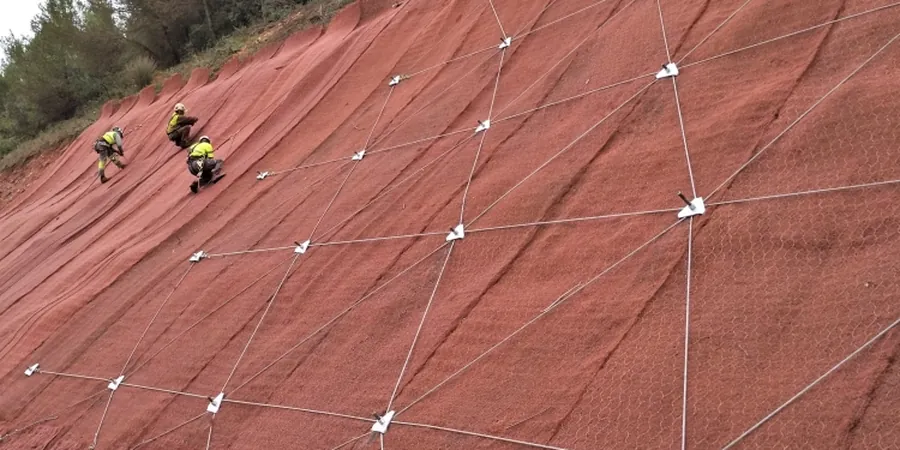
Airdrie sits at about 1,098 m above sea level on the Alberta plains, but its real geological risk is shallow groundwater perched on top of the till. After a wet spring, pore pressures rise quickly and the effective stress in a slope can drop enough to trigger a slow-moving failure. We have seen basement excavations in the Windsong area where a 4 m cut stood stable for weeks, then began to creep after a heavy rain. Our analysis flags these scenarios by modelling worst-case phreatic surfaces and, when needed, recommending drainage or a muros contencion system to retain the toe. The risk is not spectacular, but it is real and costly if ignored.
Our services
We offer two complementary service lines for slope stability analysis in Airdrie, each tailored to the project stage and site complexity.
Desktop Stability Review
For preliminary design or small residential lots, we review existing borehole logs, estimate soil parameters from local databases, and run limit-equilibrium models. Deliverables include a factor-of-safety report and recommendations for cut angles. Typical turnaround: 3–5 business days.
Full Laboratory & Modelling Package
Includes field sampling (Shelby tubes or block samples), triaxial CU/CIU testing, direct shear, and groundwater monitoring. We build a 2D finite-element model in PLAXIS, calibrate it against measured properties, and provide cross-sections with stability contours. Suitable for subdivisions, roadway cuts, and commercial pads.
Common questions
What is the typical factor of safety required for slopes in Airdrie?
For static conditions NBCC 2020 generally requires a minimum factor of safety of 1.5 for long-term stability. For short-term construction or seismic loading, we often target 1.3 and 1.1 respectively. Local municipalities may impose stricter values depending on the consequence of failure.
How much does a slope stability analysis cost in Airdrie?
For a standard residential lot with desktop review the cost ranges from CA$1.770 to CA$2.800. A full package including sampling, triaxial testing, and numerical modelling runs between CA$3.200 and CA$5.710. The final price depends on slope height, number of sections, and testing volume.
Do you need undisturbed samples for the analysis?
Yes, for cohesive soils we strongly recommend undisturbed tube samples (Shelby tubes) to measure intact shear strength. Disturbed samples can be used for index tests but will not give reliable cohesion or friction angles for the stability model. We coordinate sampling with a local drilling contractor.
What method do you use for slope stability calculations?
We primarily use the Morgenstern-Price method (satisfies both force and moment equilibrium) in SLIDE, and for complex geometries we switch to finite-element analysis in PLAXIS 2D. Both methods allow us to model pore pressures, anisotropic strength, and reinforcement layers.
Can you analyse slopes with existing retaining walls?
Absolutely. We model the wall as a structural element with soil-structure interaction. The analysis checks both global stability (slope failure passing behind or under the wall) and local wall stability (overturning, sliding, bearing). We follow CSA A23.3 for concrete wall design and NBCC for load combinations.