Airdrie sits on glacial till overlying sandstone and shale bedrock. This soil profile presents unique challenges for retaining wall design. The till is dense but contains cobbles and boulders. Water tables fluctuate seasonally near Nose Creek. We combine site-specific soil data with structural analysis to deliver walls that perform. Our team uses georradar-gpr to map subsurface obstructions before excavation. This reduces surprises during construction. Every design is calibrated to the local geology and climate.
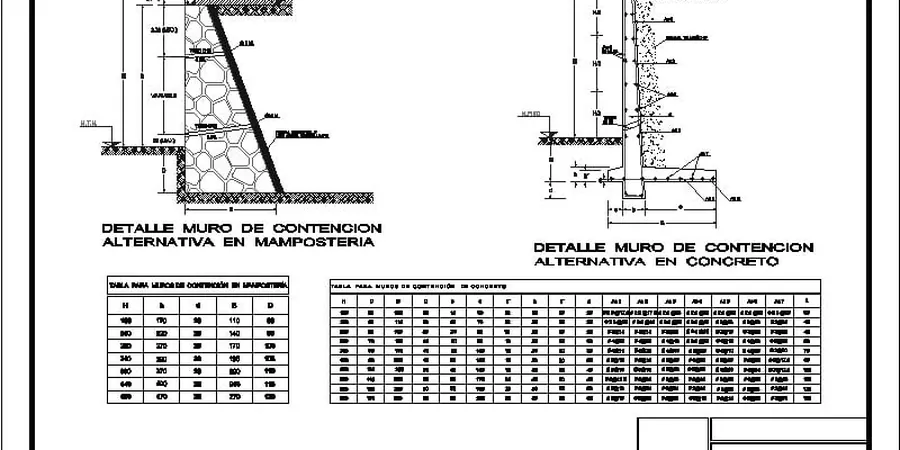
Glacial till in Airdrie is dense but unpredictable. A wall that ignores local frost depth or drainage will fail within five years.
Methodology applied in Airdrie
- Active, passive, and at-rest pressure calculations
- Global stability checks for sliding, overturning, and bearing
- Seismic acceleration factors from NBCC 2020
Risks and considerations in Airdrie
In Airdrie, the biggest risk is drainage failure. Many residential walls built without proper weep holes or gravel drains develop bulging after two winters. Another risk is underestimating the till's stiffness. It behaves well in compression but can swell when wet. We also see walls pushed by expansive clay pockets within the till. Our retaining wall design always includes a geotechnical report to quantify these factors. Ignoring them leads to costly repairs.
Our services
We offer three core retaining wall design services tailored to Airdrie's conditions.
Cantilever Retaining Wall Design
Reinforced concrete cantilever walls for heights up to 6 m. We size the stem and base slab using factored loads per CSA A23.3. Includes drainage design and joint spacing.
Segmental Retaining Wall Design
Dry-stacked block walls for residential and commercial projects. We calculate geogrid reinforcement length and spacing. Works well with granular backfill and steep slopes.
Anchored Wall Systems
Tieback or soil-nail walls for constrained sites. Used near existing foundations or right-of-ways. We design corrosion-protected anchors and verify pullout capacity with field tests.
Common questions
What is the typical cost range for retaining wall design in Airdrie?
Design fees for a standard residential wall (up to 3 m high) range between CA$1.550 and CA$5.590, depending on complexity, site access, and whether a full geotechnical investigation is needed.
Do I need a building permit for a retaining wall in Airdrie?
Yes. Any wall over 1.2 m measured from the base to top of soil requires a development permit from the City of Airdrie. Our design package includes stamped drawings to support your application.
How deep should the footing be for a retaining wall in Airdrie?
Footings must extend below frost depth, typically 1.8 m. For cantilever walls, we also verify bearing capacity in the till. In areas with high water table, we may recommend a gravel raft or deep strip footing.
What type of backfill material should I use?
Granular backfill (GW, GP, or SW) is preferred. It drains well and reduces lateral pressure. We require a minimum of 300 mm of clear gravel behind the wall with a wrapped perforated drain pipe at the base.
Can you design a wall for a sloped lot in the Canals area?
Absolutely. Sloped lots in Canals and Sagewood require tiered walls or reinforced slopes. We perform global stability analysis using Bishop's method. Each tier is designed independently with proper drainage between levels.