In Airdrie, the glacial till and lacustrine clay deposits that underlie much of the city often exhibit a stiff to very stiff consistency, but their true undrained shear strength can vary significantly within the same lot. That is why the unconfined compression test (UCS) is one of the first tools we reach for when assessing cohesive soils here. The test provides a rapid, cost-effective measure of qu (unconfined compressive strength), which directly correlates to the soil's bearing capacity for shallow foundations. Before pouring any slab on grade in the Windsong or Cooper's Crossing neighbourhoods, we typically run UCS on undisturbed tube samples to confirm that the design assumptions match the in-situ conditions. Complementing this with a clasificación de suelos helps us interpret the plasticity index alongside the strength data.
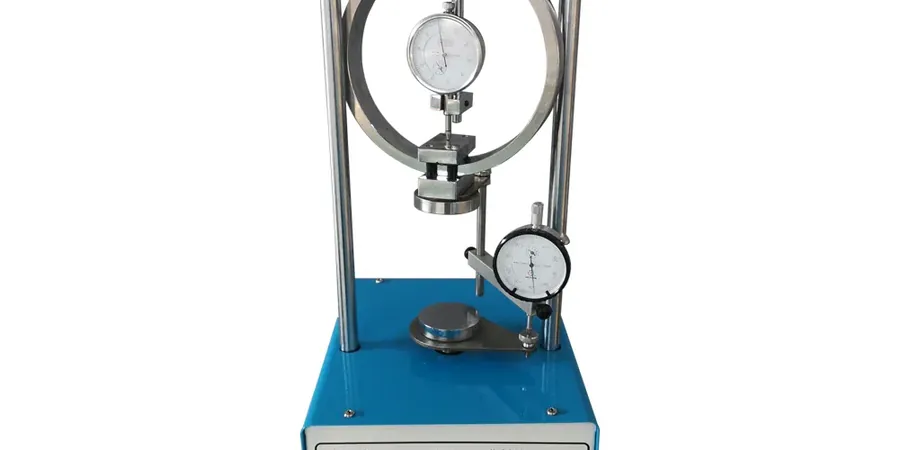
For stiff Airdrie clays, a UCS value below 100 kPa typically signals need for deeper foundation or Improvement before construction.
Methodology applied in Airdrie
- Peak compressive stress (qu) in kPa or kg/cm²
- Strain at failure (typically 2–6 % for stiff Airdrie clays)
- Stress-strain curve shape (brittle vs. ductile behaviour)
- Natural moisture content and dry density
- Saturation percentage to verify test validity
Working video
Risks and considerations in Airdrie
A three-storey townhouse project in Airdrie's Bayview district once encountered a clay layer that appeared competent during visual inspection but failed at only 85 kPa in UCS testing. The structural engineer had assumed 150 kPa for the footing design. Because we caught the discrepancy before concrete was poured, the team redesigned the spread footings and added a granular base course, avoiding a costly settlement issue two years later. That scenario repeats more often than most developers expect, especially in areas where the glacial till has been desiccated near the surface, creating a crust that masks weaker underlying clay.
Our services
We deliver the unconfined compression test (UCS) as part of a broader geotechnical suite tailored to Airdrie's geology. Each test is performed in our accredited materials laboratory, with full chain-of-custody documentation.
Routine UCS on Shelby tube samples
Standard test on 76 mm undisturbed samples from Airdrie boreholes. Includes trimming, saturation check, loading to failure, and full stress-strain report. Ideal for residential and low-rise commercial projects.
UCS with moisture-density correlation
Extended service that adds natural moisture content and dry density determination to every UCS specimen. Helps engineers in Airdrie link strength loss to seasonal moisture changes in clay till.
Common questions
How does the unconfined compression test differ from a triaxial test for Airdrie soils?
UCS applies no confining pressure, so it measures the undrained strength of cohesive soil in its natural state. Triaxial tests can simulate the confining stress at depth, which is more representative for deep foundations. For shallow footings in Airdrie's stiff clay till, UCS often provides sufficient accuracy at lower cost.
What sample quality is required for a valid UCS in Airdrie?
Only undisturbed tube samples (Shelby or piston) are acceptable. Samples must be extruded, trimmed, and tested within 72 hours of extraction to avoid moisture loss. Disturbed or remoulded specimens will produce unreliable qu values.
Can UCS alone determine bearing capacity for a house foundation in Airdrie?
UCS gives the undrained shear strength (su = qu/2), which is a direct input to bearing capacity formulas. However, we recommend combining it with a soil classification and at least one Proctor compaction test for fill areas. Many Airdrie sites require both UCS and SPT to confirm stratification.
What is the typical cost range for a UCS test in Airdrie?
The typical cost for a standard unconfined compression test in Airdrie ranges from CA$400 to CA$630 per sample, depending on the number of specimens and whether moisture-density correlation is included. Volume discounts apply for multi-sample projects.