Airdrie sits at roughly 1,098 meters above sea level on the western edge of the Alberta Plains, where glacial till and lacustrine deposits dominate the subsurface. These soils can vary dramatically within a single lot, so a thorough soil mechanics study is non-negotiable before breaking ground. We have processed over a hundred samples from sites around Yankee Valley Boulevard and the new developments near CrossIron Mills, and the pattern is clear: the clay till here has medium to high plasticity, often resting on dense sand or gravel layers. For residential basements or light commercial slabs, we routinely combine shallow test pits with a granulometría and Atterberg limits to classify the material correctly. When a project calls for deeper foundations, we recommend pairing the study with an ensayo SPT to obtain direct refusal data and correlate it with bearing capacity tables from the NBCC.
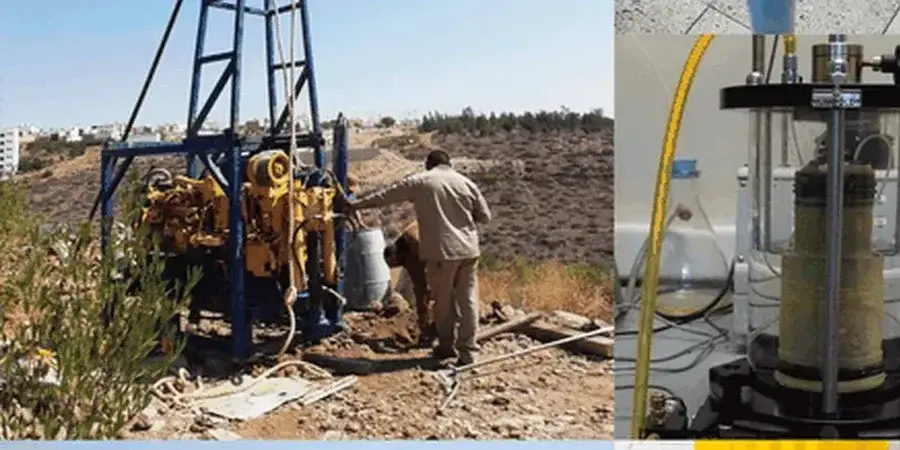
In the glacial till around Airdrie, a single borehole can miss a sand lens that changes the bearing layer entirely — multiple probes reduce that risk.
Methodology applied in Airdrie
Working video
Risks and considerations in Airdrie
One risk we see often in Airdrie is the presence of old buried channels — ancient glacial meltwater paths filled with loose sand or silt. If a soil mechanics study only uses two boreholes and misses one of these channels, the foundation may settle unevenly. Another concern is the seasonal frost depth, which reaches about 1.8 meters here. If the study does not account for frost-susceptible silts, heave can crack basement walls within two winters. We flag these hazards in every report and recommend mitigation like gravel replacement or deep footings below the frost line. A full study with proper sampling intervals catches these issues before concrete is poured.
Our services
We structure each soil mechanics study around three core phases so that nothing gets overlooked:
Field Exploration and Sampling
Auger and split-spoon boreholes, Shelby tube sampling of undisturbed clay till, and standard penetration tests at 1.5-meter intervals. We record water levels and log each stratum photographically.
Laboratory Classification and Strength Tests
Full soil classification (USCS and AASHTO), natural moisture content, Atterberg limits, unconfined compression, and direct shear tests. Results are tabulated and plotted for bearing capacity and settlement analysis.
Geotechnical Report and Foundation Recommendations
A written report covering site geology, test results, allowable bearing pressures, settlement estimates, frost protection requirements, and construction considerations specific to Airdrie's glacial till.
Common questions
How much does a soil mechanics study cost in Airdrie?
For a typical single-family lot in Airdrie, expect between CA$4.700 and CA$6.960, depending on borehole depth, number of samples, and lab tests. A two-borehole study with basic classification and bearing capacity sits near the lower end; multi-borehole studies for townhouses or commercial work climb toward the upper range.
How deep do boreholes need to go for a soil mechanics study in Airdrie?
That depends on the foundation load and local soil conditions. In Airdrie, the active zone for frost is about 1.8 meters, and the bearing stratum (dense till) is often 2 to 5 meters deep. For single-family homes, we typically go 4 to 6 meters; for three-story buildings, 8 to 12 meters. The NBCC requires exploration to at least 1.5 times the footing width below the bearing level.
What does the laboratory phase of a soil mechanics study include?
After field sampling, we run natural moisture content, Atterberg limits, sieve analysis, and Proctor compaction on representative samples. For bearing capacity, we perform unconfined compression or direct shear tests. If the project involves slabs on grade, we add consolidation testing to estimate settlement under the proposed loads.
Can a soil mechanics study identify expansive soils in Airdrie?
Yes. We measure the plasticity index and linear shrinkage of the clay till. Airdrie's till typically has a PI between 18 and 28, which indicates moderate shrink-swell potential. If the PI exceeds 30 or the linear shrinkage is above 8%, we flag the soil as expansive and recommend foundation reinforcement, soil modification, or deep footings below the active zone.