In the geotechnical landscape of Airdrie, the laboratory serves as the critical backbone for de-risking construction and infrastructure development. This category encompasses the full spectrum of physical and mechanical testing performed on soil and aggregate samples extracted from boreholes and test pits. By moving beyond visual classifications to precise quantitative analysis, we transform raw earth into reliable engineering parameters. For projects across the Calgary Metropolitan Region, understanding the specific index properties of the local substrate is not merely a regulatory checkbox; it is a fundamental step in preventing differential settlement, slope instability, and long-term pavement failure.
The geological context of Airdrie demands rigorous laboratory scrutiny. The city is situated on the Western Canada Sedimentary Basin, characterized by complex glacial stratigraphy left by the retreat of the Laurentide Ice Sheet. This has resulted in a heterogeneous profile dominated by glacial till—an unsorted mixture of clay, silt, sand, and boulders—overlying Cretaceous bedrock, primarily the Bearpaw Formation shales. The high plasticity of the near-surface clays, often prone to significant volume changes with seasonal moisture fluctuation, makes tests like the Atterberg limits essential. Without accurately determining the Liquid Limit and Plasticity Index, engineers cannot predict the heave potential or the reactive nature of the soil, which is a primary concern in local residential and commercial foundations.
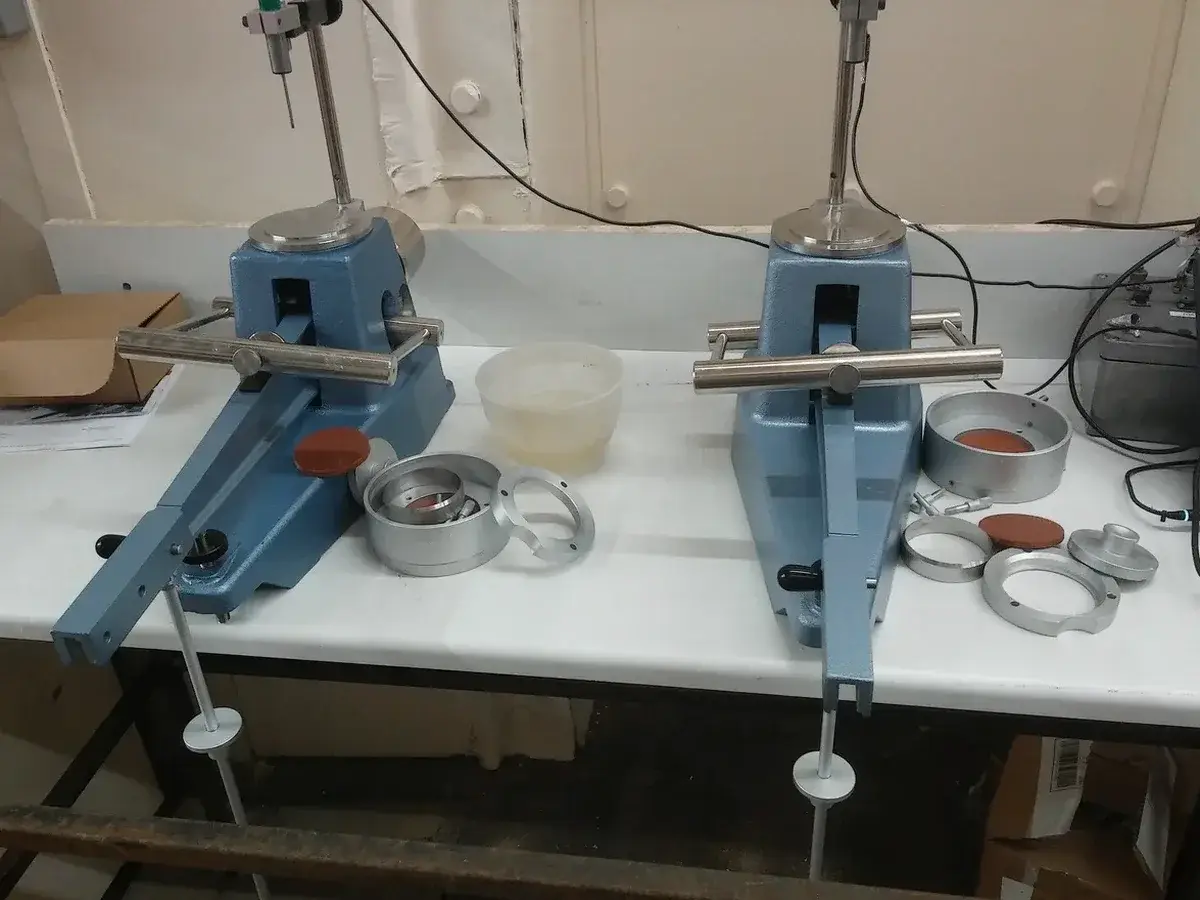
Regulatory compliance in Airdrie is governed by the Alberta Building Code, which references national standards set by the Canadian Standards Association (CSA) and the American Society for Testing and Materials (ASTM International). However, the specific execution of laboratory work must align with the geotechnical guidelines provided by the City of Airdrie and the broader standards practiced by the Association of Professional Engineers and Geoscientists of Alberta (APEGA). A comprehensive soil mechanics study integrates multiple testing methodologies to meet these professional practice standards. Key tests, such as the Proctor test, are strictly conducted in accordance with ASTM D698 (Standard) or D1557 (Modified) to establish compaction specifications that prevent future settlement under structural loads.
The demand for these laboratory services spans a wide array of project typologies. From greenfield residential subdivisions in the Windsong and Hillcrest communities to commercial builds along Yankee Valley Boulevard, every shallow and deep foundation design relies on accurate shear strength data. The unconfined compression test is frequently employed to assess the undrained shear strength of cohesive clay samples, providing a direct input for bearing capacity calculations. Furthermore, infrastructure projects, including road widening and utility trench backfill, depend on grain size analysis to ensure imported materials meet strict gradation envelopes for frost heave protection and drainage competency.
Common questions
Why is a dedicated geotechnical laboratory program necessary instead of relying solely on visual field logging in Airdrie?
Visual logging cannot quantify critical engineering properties like moisture content, plasticity, compaction potential, or shear strength. Airdrie’s glacial tills often contain highly plastic clays that look similar to stable silts in the field but behave very differently under load. Laboratory testing provides the numerical data required for structural engineers to design foundations that safely accommodate settlement and seasonal volume changes.
How do local standards like APEGA influence the laboratory testing process for Airdrie projects?
APEGA requires that all geotechnical laboratory data be generated under the supervision of a licensed professional engineer who validates the results. This ensures that testing methods strictly adhere to ASTM or CSA standards. The professional must interpret the laboratory data in the context of the local geology, ensuring the final report meets the standard of care expected for Alberta’s regulatory environment.
What sample conditions are required for reliable laboratory results on Airdrie’s clay-rich soils?
For cohesive soils common in Airdrie, Shelby tube samples must be sealed immediately to preserve in-situ moisture content. Disturbed bag samples are suitable for classification and Proctor tests, but undisturbed samples are critical for shear and consolidation testing. Any drying or disturbance during transport can significantly underestimate the plasticity and settlement potential of the local glacial till.
How do laboratory compaction tests reduce long-term maintenance issues for pavements in Airdrie?
Standard or Modified Proctor tests establish the moisture-density relationship of the subgrade. By specifying compaction to a percentage of the maximum dry density at the optimum moisture content, engineers prevent future rutting and frost heave. This is vital in Airdrie’s freeze-thaw climate, where poorly compacted clay subgrades absorb water and lose structural integrity during spring thaw.