Airdrie sits on glacial till and lacustrine deposits, with clay layers reaching up to 8 metres in depth. Groundwater fluctuates seasonally near Nose Creek. For any earthworks project here, getting the geotextile specification right controls long-term performance. We specify woven and non-woven fabrics based on grab strength, permittivity, and AOS. For retaining walls or subgrade separation, we pair the geotextile design with a plate load test to confirm bearing capacity before placement. That data also validates the assumed soil-geotextile interaction parameters.
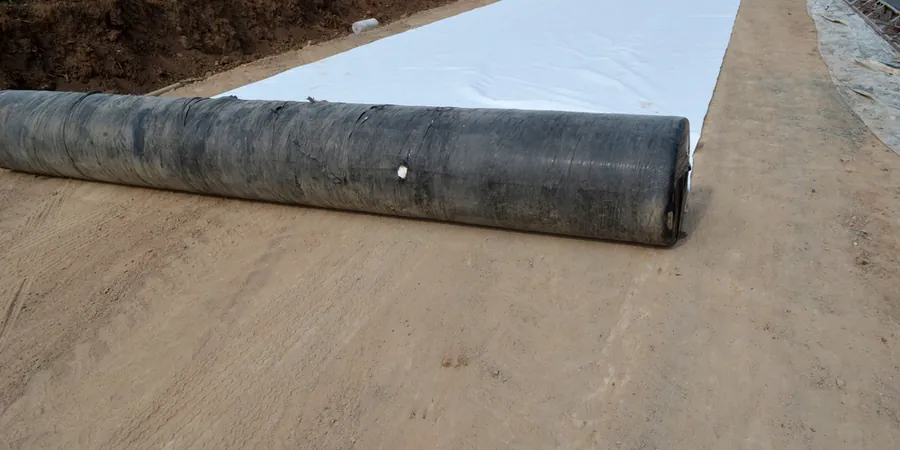
In Airdrie's clay till, a geotextile with permittivity below 0.2 s⁻¹ can trap pore water and trigger subgrade softening within one freeze-thaw cycle.
Methodology applied in Airdrie
Working video
Risks and considerations in Airdrie
NBCC 2019 and CSA A23.3-19 require that separation layers prevent pumping and loss of fines. In Airdrie, the high-plasticity clay till (CH) can clog a geotextile with low AOS. The risk is real: blocked fabrics reduce drainage, increase pore pressure, and lead to shear failure under roads or behind walls. We always cross-check the geotextile specification against the soil's D₈₅ and the hydraulic gradient. Ignoring this step in Airdrie's glaciolacustrine soils can cause differential settlement within two winters.
Our services
Our geotextile specification service in Airdrie covers every stage from material selection to field verification. We tailor each spec to your project's loading and drainage needs.
Material Selection & Spec Writing
We analyse soil gradation, groundwater levels, and design loads to choose woven or non-woven fabrics. Deliverable: a site-specific spec sheet with ASTM references and installation notes.
Field Quality Control & Testing
Our technicians verify fabric placement, lap widths, and cover thickness. We sample rolls for grab strength and permittivity checks in our ISO 17025 lab.
Design Review & Troubleshooting
If a geotextile failed on site — clogging, tearing, or bulging — we diagnose the cause and rewrite the spec. We review contractor submittals for compliance with project drawings.
Common questions
What ASTM standards apply to geotextile specification in Airdrie?
We use ASTM D4595 for wide-width tensile, ASTM D4632 for grab strength, ASTM D4491 for permittivity, and ASTM D4751 for AOS. For installation we follow ASTM D4759. These align with NBCC 2019 separation requirements.
How much does a geotextile specification service cost in Airdrie?
Our typical cost ranges from CA$610 to CA$1,550 depending on project complexity, number of fabric types, and whether field sampling is included. Contact us for a quote.
What is the difference between woven and non-woven geotextile for Airdrie subgrades?
Woven fabrics have high tensile strength (40–100 kN/m) and work well for reinforcement under roads. Non-woven fabrics offer higher permittivity (0.5–1.5 s⁻¹) and are better for drainage and separation in clay till. We select based on CBR and grain size.
Can I reuse the same geotextile spec from a project in Calgary?
Not directly. Airdrie's clay till has higher plasticity (CH) and lower permeability than many Calgary sites. The AOS and permittivity values need adjustment. We also account for local freeze-thaw cycles that differ from downtown Calgary.