Under the 2020 National Building Code of Canada (NBCC), any structure in Airdrie requires a clear understanding of subsurface conditions. Given the city's geology — glacial till overlying sandstone and shale of the Paskapoo Formation — electrical resistivity and VES surveys are especially relevant. These non-invasive methods map lateral and vertical variations in soil resistivity without drilling, making them ideal for initial site screening. In Airdrie, where pockets of high groundwater and variable bedrock depth are common, combining VES profiles with calicatas exploratorias gives you a cost-effective way to identify risks before detailed geotechnical work begins.
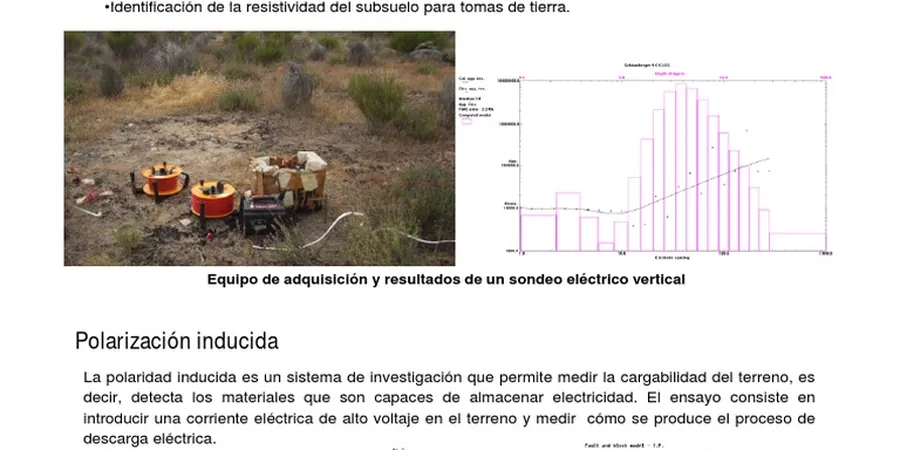
A single VES profile can map the depth to shale bedrock within ±1 m, saving weeks of exploratory drilling time on large residential subdivisions.
Methodology applied in Airdrie
- Electrode spacing: 2 m to 20 m
- Array type: Wenner and Schlumberger
- Depth of investigation: up to 40 m
- Inversion software: Res2DInv or EarthImager
Risks and considerations in Airdrie
Here's what we see often in Airdrie: a developer clears a site, starts excavating for a basement, and hits a perched water table or a buried channel filled with sand. That's a change order costing thousands. VES surveys catch these heterogeneities early. In the Copperfield area, for example, a VES line revealed a paleochannel cutting through the till — something boreholes alone missed. If you skip this step, you're betting on uniform ground that doesn't exist. We recommend at least one VES transect per hectare in Airdrie's suburban developments to avoid surprises during foundation construction.
This service complements our laboratory testing work for a complete project analysis.
Our services
We tailor electrical resistivity surveys to Airdrie's specific geotechnical challenges. Whether you need a quick VES sounding for a single lot or a full 2D resistivity grid for a subdivision, our team delivers actionable data.
Vertical Electrical Sounding (VES)
1D resistivity profiling at a single point to determine depth to bedrock, water table, and clay layers. Ideal for small residential lots in Airdrie.
2D Resistivity Imaging (ERT)
Multi-electrode arrays producing cross-sectional images of the subsurface. Best for large subdivisions or linear infrastructure projects (roads, pipelines).
Time-Lapse Resistivity Monitoring
Repeated surveys over weeks or months to track groundwater changes, dewatering effects, or compaction progress. Useful for long-term projects in Airdrie.
Integration with Geotechnical Borings
We calibrate resistivity models against actual soil samples from boreholes. This hybrid approach reduces drilling costs while maintaining high confidence in interpretations.
Common questions
What is the difference between 1D VES and 2D ERT?
A 1D VES uses a single line of electrodes at one location to measure resistivity changes with depth. It's quick and cost-effective for point-specific questions. 2D ERT uses multiple electrodes along a profile to create a cross-sectional image, showing lateral changes like buried channels or faults. For Airdrie's varied till deposits, 2D ERT offers better spatial resolution.
How deep can a VES or ERT survey reach in Airdrie's soils?
With our standard 2 m electrode spacing, we reach about 10–15 m depth. Using 20 m spacing, we can image down to 30–40 m. The actual depth depends on resistivity contrast — dry till and shale give clear signals, while saturated clay layers can attenuate the signal. We recommend a site visit to confirm the optimal configuration.
How much does a typical electrical resistivity survey cost in Airdrie?
For a standard residential lot (1–2 VES points), the cost ranges from CA$790 to CA$1,610, depending on access and required depth. A full 2D ERT line for a subdivision (200–400 m) typically runs CA$2,500 to CA$5,000. These are reference prices; final quotes depend on site conditions and reporting level.