Diaphragm wall design in Airdrie follows the National Building Code of Canada 2020 and CSA A23.3 for concrete structures. Airdrie sits on glacial till overlying sandstone and shale of the Paskapoo Formation, with water tables fluctuating between 3 and 8 m depending on season. The stiff clay till can reach undrained shear strengths of 150–300 kPa, which is favorable for panel stability, but artesian conditions in the bedrock layer require careful hydraulic assessment. Before finalizing the wall geometry, we run a presurometer test to measure in-situ lateral stiffness and relaxation modulus at depth.
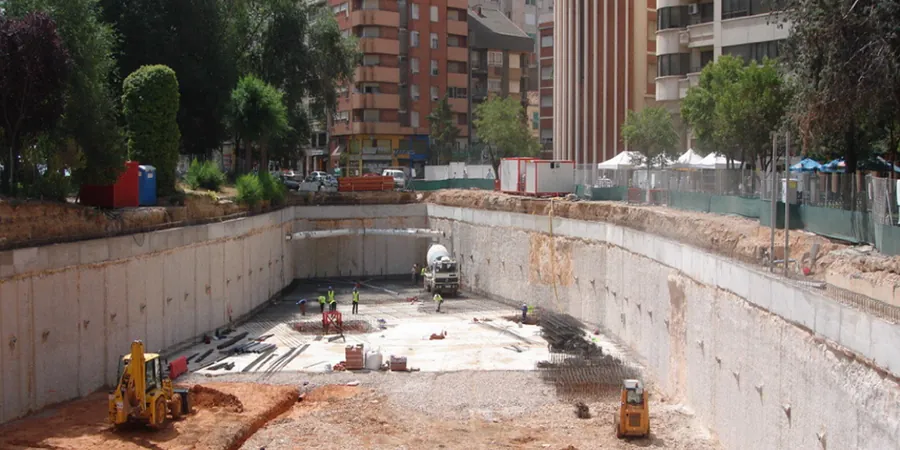
Glacial till in Airdrie provides high side friction but perched water in sand lenses often dictates the choice between reinforced and secant pile diaphragm walls.
Methodology applied in Airdrie
- Panel layout optimized for Airdrie's till stratigraphy — typical panel widths of 2.5–3.0 m
- Stop-end tubes or hydrofraise cutters depending on accessibility and depth (12–22 m typical)
- Reinforced concrete walls with vertical post-tensioning where groundwater cutoff is required
Working video
Risks and considerations in Airdrie
The south side of Airdrie near Yankee Valley Boulevard and the older core around Main Street have very different soil profiles. South Airdrie often encounters 2–4 m of soft clay and silt over till, while the core area sits directly on stiff till. That contrast changes how we assess panel stability and tremie concrete placement. If the bentonite slurry density is not adjusted for the softer upper layers, filter cake formation can be poor, leading to caving or necking. A diaphragm wall design that works on one block may need full re-analysis just a few streets away.
This service complements our laboratory testing work for a complete project analysis.
Our services
We offer three complementary diaphragm wall services tailored to Airdrie's subsurface conditions.
Structural wall design with post-tensioning
Reinforced concrete panels designed for deep basements and cut-and-cover tunnels, including vertical post-tensioning where groundwater uplift exceeds 50 kPa.
Secant pile diaphragm walls
Interlocking secant pile walls for tight urban sites where vibration must be minimized and groundwater cutoff is critical.
Temporary shoring with shotcrete facing
Soldier pile and shotcrete walls that serve as temporary support before permanent diaphragm walls are cast, ideal for staged excavation.
Common questions
What is the typical cost range for diaphragm wall design in Airdrie?
For a mid-rise basement with panels 15–20 m deep, the design and testing scope usually runs between CA$2,700 and CA$8,630. Final cost depends on wall length, reinforcement density, and number of watertight joints.
How deep do diaphragm walls need to be for Airdrie's till and bedrock?
Depths range from 12 m in stiff till to 22 m where the wall must key into the underlying Paskapoo sandstone. The embedment ratio into bedrock is typically 1.0–1.5 times the excavation height.
Can diaphragm walls handle the perched water tables common in Airdrie?
Yes, provided the bentonite slurry density is raised to 1.10–1.15 g/cm³ and tremie concrete is placed continuously. We also specify waterstop joints at every panel connection.
What soil parameters are most critical for diaphragm wall design in Airdrie?
Undrained shear strength of the till, lateral modulus of subgrade reaction, and the hydraulic head in the sandstone layer. These three values drive panel stability, bending moments, and tieback anchor loads.